How to Trim a Beard: A Step-by-Step Guide for Every Face Shape
Not sure what to fix first? Get your free AI score in 60 seconds.
Take the Free TestMost men do not have a bad beard. They have a well-grown beard with a badly placed neckline, a cheek line that drifts up the face, and a length that fights their jaw instead of building it. Trimming is not about removing hair — it is about drawing edges. This guide walks the whole process in the order a barber does it, then matches a shape to your face.
What you actually need
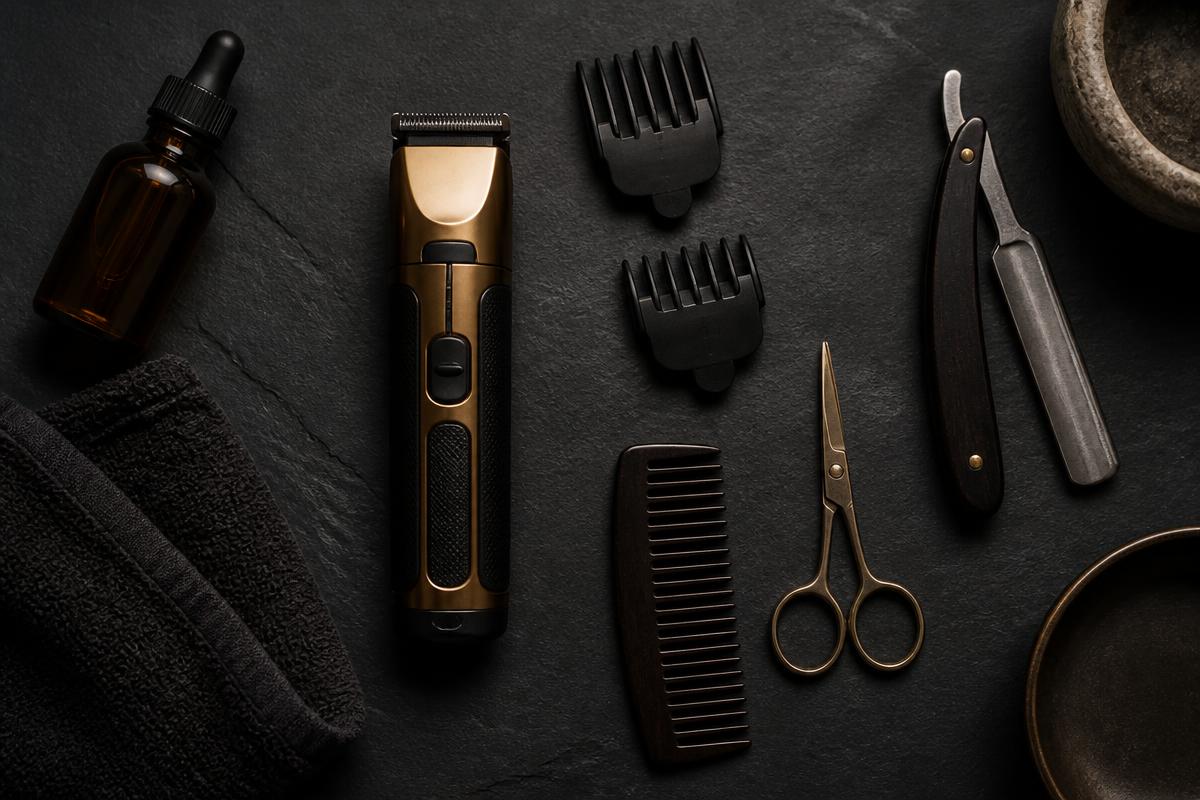
You can do a clean trim with five items. Everything beyond this is optional comfort.
- A beard trimmer with adjustable guards — anything covering 1 mm to 12 mm is enough.
- A detail trimmer or a single-blade razor for the neckline and cheek line.
- A fine-tooth beard comb to lift hair to a uniform angle before cutting.
- Small grooming scissors for stray hairs on the moustache and around the lips.
- Beard oil or a light balm to settle the hair once you are finished.
Before you switch anything on
- 1Trim dry. Wet hair stretches and springs back shorter than you intended, which is how one careless pass turns into a full reset.
- 2Wash and fully dry the beard, then comb it downward so every hair sits in its natural direction.
- 3Stand at eye level with good front lighting. Overhead bathroom light hides the neckline in shadow — the single most common cause of a bad trim.
- 4Decide your target length before you start, not halfway through. You can always take another millimetre off; you cannot put it back.
The trimming sequence, step by step
1. Set the overall length
Start one guard longer than you think you need. Run the trimmer against the grain — upward from the jaw toward the cheek — in overlapping passes, keeping the head flat against the face. Do the whole beard at this length before judging it. If it still reads bushy, drop one guard and repeat. Two conservative passes beat one aggressive one.
2. Taper the sides
The beard should be shortest at the temples and cheeks and longest at the chin. That gradient is what creates a longer, stronger looking jaw. Practically: use a guard one to two steps shorter on the upper cheeks and sideburns, then blend the transition by moving the trimmer in a gentle flicking motion away from the face so no hard line appears.
3. Cut the neckline
Place two fingers above your Adam's apple. That is the bottom of your beard. Draw an imaginary curved line from behind one ear, down to that point, and back up to the other ear — a soft U, not a straight horizontal band. Everything below it comes off completely. Do not follow the jawline itself: a neckline cut along the jaw removes the shadow that separates chin from neck and instantly adds years and softness.
4. Cut the cheek line
Leave it as high and as natural as your growth allows. If your growth is patchy or the line looks ragged, tidy it with a shallow curve that runs from the sideburn toward the corner of the moustache — never a steep diagonal. A high, softly cleaned cheek line looks full. A low, aggressively shaved one makes the face look narrow.
5. Moustache and lip line
Comb the moustache down and take only the hairs crossing the top lip, using scissors rather than the trimmer for control. Keep the moustache slightly longer than the beard — it frames the mouth and stops the beard reading as a uniform mask.
6. Finish
Rinse in cool water, pat dry, then work three to five drops of beard oil from the skin outward. This is not vanity: oil stops the flaking and itch that make a good beard look neglected within two days.
Want to know which of these actually applies to you? Caliber scores your own photo — hair, beard, skin, style and first impression — free, in about 60 seconds.
Get My Free ScoreThe best beard style for your face shape
The rule behind every row below is simple. A beard should move your face toward an oval: add length where the face is wide, add width where the face is narrow.
| Face shape | Goal | Beard style that works | Avoid |
|---|---|---|---|
| Round | Add vertical length, remove width | Short boxed beard with a longer, squared chin and tight, tapered cheeks | Full cheek coverage, mutton chops, circle beards |
| Square | Soften a strong jaw | Even short beard or light stubble that follows the jaw softly | Hard geometric edges and heavy chin bulk |
| Oval | Keep balance | Almost anything — short boxed, stubble, or a full beard | Extreme length that drags the face down |
| Oblong / long | Add width, reduce length | Fuller cheeks, moderate length, flat-cut chin | Goatees, pointed chins, long chin-only beards |
| Diamond | Add weight at the chin | Fuller chin and jaw, lighter cheeks | Wide cheek coverage |
| Triangular / heart | Balance a narrow chin | Full beard with volume at the jaw and chin | Thin chinstraps |
Five mistakes that ruin an otherwise good beard
- 1Neckline cut along the jaw. Erases the jaw entirely. Two fingers above the Adam's apple, always.
- 2Trimming wet. Everything ends up shorter than planned.
- 3Uniform length everywhere. No taper means no shape — the beard reads as a helmet.
- 4Chasing symmetry. Every face is slightly asymmetric; correcting it hair by hair ends with almost no beard left.
- 5Skipping the moustache. An untouched moustache makes a freshly trimmed beard look unfinished.
A maintenance schedule that keeps it sharp
| Frequency | Task |
|---|---|
| Daily | Comb down, apply oil, take obvious strays with scissors |
| Every 2–3 days | Clean the neckline — it grows fastest and shows first |
| Weekly | Reset the overall length and re-blend the cheek taper |
| Every 4–6 weeks | Barber visit to re-cut the shape if you wear a longer beard |
Not sure which beard shape fits your face? Caliber's free AI attractiveness test reads your face shape, jawline and current facial hair from one photo and tells you what to change first — no signup, under 60 seconds.
Take the Free TestCommon questions
How short should stubble be?
Roughly 3 mm. Shorter reads as unshaven, longer starts to lose the shadow effect that defines the jaw. A 3 mm guard once every two or three days maintains it indefinitely.
How do I deal with patchy growth?
Keep everything short enough that the patch is not a hole — usually 3–6 mm — and give the beard four full weeks before judging it. Growth fills in unevenly and most patches close by week three.
How often should I trim?
Weekly for the overall shape, every two to three days for the neck. Beards look unkempt from the edges inward, so edges are what you maintain.